
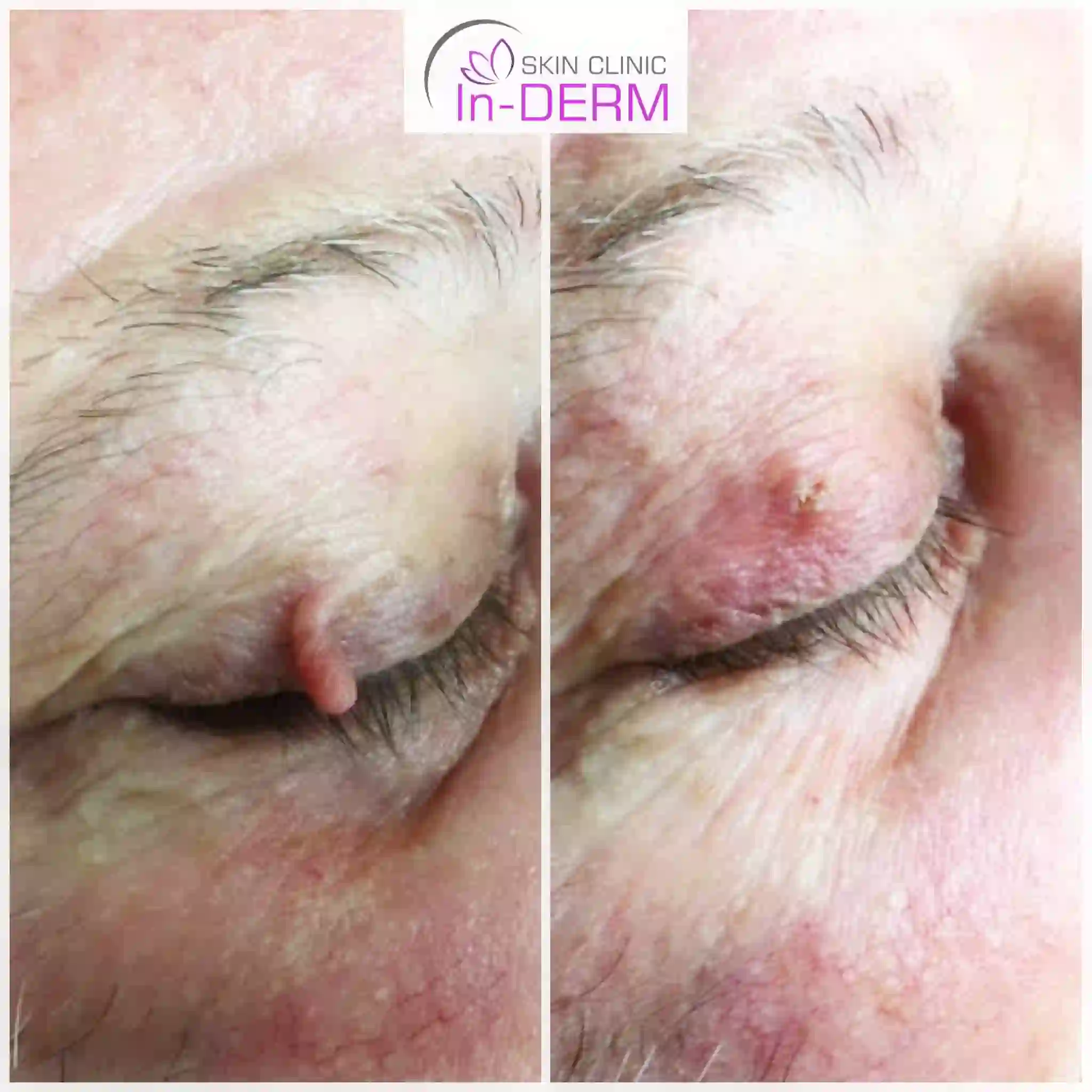
If you’re thinking about removing a skin tag on or near the eyelid, you’re probably wondering two things: what will it look like after, and how long will healing take. At Chelsea, In-DERM Skin Clinic in Chelsea, we use careful, medical-grade techniques to treat delicate peri-ocular skin. For most clients, it’s a brief appointment followed by a tiny scab and a faint pink dot that blends over the next couple of weeks. Below, we show what typical before and after results look like on camera, what happens day-by-day, and how to look after the area so it heals neatly.
What “Before” Looks Like (and Why It’s Noticeable)
Eyelid skin tags, usually soft, stalked acrochordons tend to catch light and shadow more than tags elsewhere. In close-up photos or under make-up, they can create a little bump where mascara clumps or where lashes snag. If the tag sits in the crease, it can break a smooth eyeliner line or make the lid look slightly uneven. That’s the “before” most people want to tidy.
The “After” You Can Expect (Realistic View)
Immediately after removal, the area looks clean but not “photoshoot ready”: you’ll usually see a pinpoint scab and a slight pink halo. This is normal and expected on thin eyelid skin. By the end of week one the scab has usually lifted on its own, leaving a small pink spot that settles progressively. Between weeks two and three, tone evens out and the light reflects smoothly across the lid or crease again. By weeks four to six, most complexions look fully blended in typical lighting.
What your photos tend to show:
- Before: a raised bump that catches light; make-up collects around it.
- After week 2: a smooth contour without a catch-point; make-up glides more evenly.
- After week 4–6: tone has blended; the area looks like the surrounding skin.
How We Remove Eyelid Skin Tags (and What It Feels Like)
Most eyelid-area skin tags are removed using advanced electrolysis, which delivers controlled heat to safely treat the tissue. This precise technique allows the tag to be removed while sealing tiny blood vessels at the same time, helping to minimise bleeding and support faster healing. A topical anaesthetic is used and, where appropriate, a small amount of local anaesthetic may be applied. Clients usually describe the sensation as mild pressure with brief warmth or a quick pinch, typically rated around 1–4 out of 10 on a simple pain scale. The procedure is quick, and protective eye measures are used throughout to ensure safety.
Day-by-Day Healing Timeline (Short and Honest)
Days 0–1: You’ll notice a small, well-bounded scab and mild pinkness. The area can feel tender for a few hours and settles with a wrapped cool compress. Keep the eye area clean and avoid make-up for 24–48 hours.
Days 2–4: The scab darkens a touch as it dehydrates. Don’t pick. Gentle cleansing with eyes closed and light occlusive if advised are enough. Avoid steam rooms, hot yoga, or heavy sweat so the scab stays intact.
Days 5–7: The scab usually loosens and drops away on its own. Underneath, you may see a fresh pink spot. Begin daily mineral SPF on the surrounding skin (avoid getting product in the eye).
Days 8–14: Pinkness fades and blends into your tone. Most clients feel “camera-ready” by two weeks, especially with natural daylight photography.
Weeks 3–6: Subtle blending continues. Side-by-side photos show a clean contour where the tag used to be, and make-up applies more smoothly across the lid and crease.
Please get in touch if you notice spreading redness after 48 hours, increasing pain, pus, unusual swelling, blurred vision, or any new or worsening eye symptoms.
Setting Up Fair Before-and-After Photos
If you want a clear record, take your before photo in indirect daylight, no make-up, eyes gently closed, and the same angle each time (front and a slight 45°). Repeat at day 2, day 7, and week 3. Consistent lighting makes small changes obvious.
Safety First: Who We Treat and Who We Refer
We’re happy to treat typical, soft, stalked tags near the eyelid in-clinic. If a lesion touches the lash line, bleeds spontaneously, grows quickly, or looks atypical (e.g., not a classic acrochordon), we’ll co-manage or refer to an ophthalmic specialist. We’ll also ask you to pause strong actives (acids/retinoids) around the eye for a few days before and after treatment so the skin stays calm.
Aftercare that Protects the Result
Keep cleansing gentle, avoid rubbing, and don’t pick the scab. A thin occlusive (if advised) helps the spot stay supple. Once the surface has closed, apply broad-spectrum mineral SPF to the surrounding skin every morning this reduces the chance of post-inflammatory pigmentation. Eye make-up can usually return after 24–48 hours when the surface is calm and closed; remove it softly (no scrubbing) for the first week. Avoid steam rooms, saunas, or heavy sweat until crusting has lifted.
What About Marks, Pigment, or Scars?
On eyelid skin, visible scarring is uncommon when treatment is conservative and aftercare is followed. A faint pink dot is expected for a short time; in deeper skin tones, temporary darkening is possible and usually fades with sunscreen and patience. The biggest risks for marks are picking and unprotected sun both are avoidable.
Costs and Planning (Indicative)
Eyelid-adjacent tags typically sit around £160–£270 in london for a single small lesion; nearby tags treated in the same visit are usually discounted per-tag or as a small cluster. A routine follow-up check is often included; retreatment is rarely needed and would be quoted case by case. Treating multiple tags in one appointment is often more efficient, provided comfort and safety are maintained.
Frequently Asked Questions
Will the same tag come back?
No, the treated tag shouldn’t regrow. New tags can appear over time in friction-prone folds; if they do, they’re usually quick to tidy.
When can I wear eye make-up?
Usually after 24–48 hours, once the surface is closed and calm. Choose gentle formulas and remove with minimal pressure.
Is it painful?
Most people report brief pressure or a quick pinch. Sensitivity varies by position, but sessions are short and controlled.
Can you treat the lash line?
We assess first. Tags on the lash line or true lid margin are co-managed or referred for specialist care for your safety.
Can I DIY this?
No. Near the eye, at-home tools, string, or acid pens carry real risk. Professional assessment and protective techniques are essential.
The Takeaway
Before: a small bump that catches light and interrupts a smooth make-up line.
After: a neat, flat contour with even tone usually within one to two weeks, with further blending over the next month. With eye-safe technique and simple aftercare, the result looks tidy in the mirror and in close-up photos.
Book Your Consultation
Ready for a clean, confident after? Book your eyelid skin tag removal at In-DERM Skin Clinic in Chelsea. We’ll confirm suitability, agree on the gentlest effective method, and guide you through healing step by step so your before-and-after looks exactly as it should: neat, natural, and comfortable.